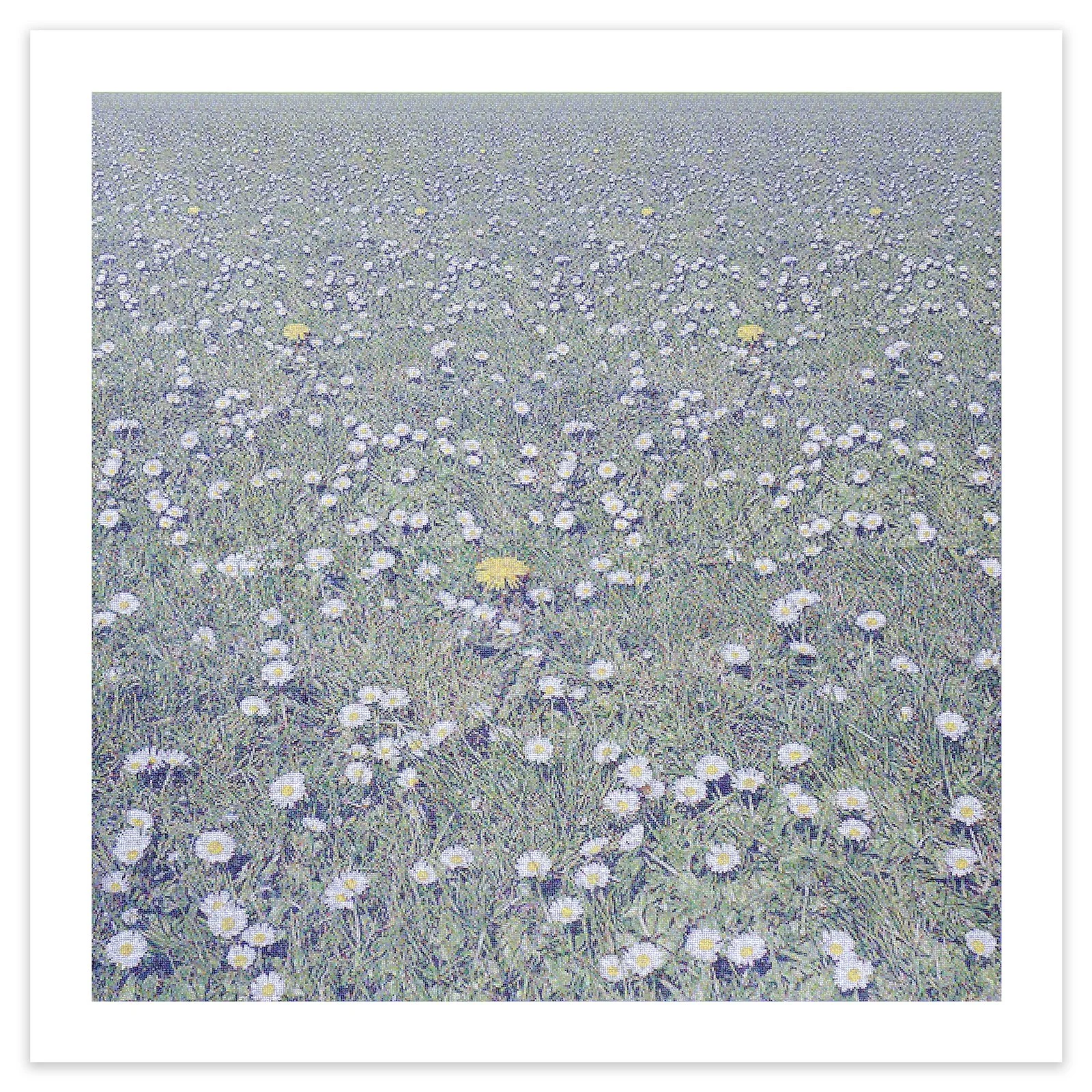
Daisyworld 2.0 (2017/2026)
Archival pigment inkjet (giclée) print on Hahnemühle Photorag paper (308gsm).
60cm x 60cm / 23.6” x 23.6” (a standard frame size).
53cm x 53cm / 20.8” x 20.8” (image size)
Edition of 128
£150 (+shipping)
The print number (n/128) is printed in the bottom right-hand corner.
A certificate of authenticity accompanies the print.
Shipping costs are calculated at the checkout when your address is entered.
This print is based on a photograph of my painting Daisyworld 2.0 (2017), oil on canvas, 195x195 cm. For the print I chose a narrow border as the image implies an expanding field of daisies, going on forever in all directions.
The scientist and originator of the Gaia Hypothesis, James Lovelock (1919-2022), was born in Letchworth (the original Garden City). In 1983 he developed the Daisyworld computer model with mathematician Andrew Watson to try and prove his theory that the Earth can be understood as a self-regulating organism, the biosphere providing feedback mechanisms (with white and black daisies) that compensate for the variable effects of solar or volcanic activity within certain bounds.*
My first Daisyworld painting (responding to being invited to show in a new public art gallery in Letchworth) is adorned with an array of little flowers across a low-resolution painting of suburban or quasi-rural houses. They’re positioned in spaces where the top layer of the painting left open squares due to a complex system of curved diagonal brushstrokes. There’s a sense that the flowers are naturally colonising spaces in a simplified version of what weeds do. [A full account of my Letchworth adventure will hopefully find textual form with other print editions]
For the second Daisyworldpainting I had a different plan. The house where Lovelock spent his early years was next to Norton Common, the largest green expanse in Letchworth. I photographed the daisies there, taking dozens of pictures. The conceit was to frame a horizontal 2 x1 rectangle, with a resolution of 512x256 pixels, which would tessellate into a repeating pattern, constructing an image that would depict a receding field of flowers, expanding to the top of a square painting.
Working through many variations, it became clear that the image needed to give the impression of a continuous, vast field of flowers, while subtly showing its seams. The inclusion of a solitary dandelion, repeating in a triangular formation helped considerably.
In its development in Photoshop, an average was taken of the colour of the 261,632 pixels. The flat background layer was painted in a shade of lilac: a chromatic inversion of this averaged colour. The narrow spaces between the painted pixels accentuate the sense they are floating upon the painting’s woven canvas matrix, a completely artificial screen.
Daisyworld 2.0 presents nature scanned, digitised, and hermetically enclosed in an infinitely repeating pattern. As the resolution diminishes by half at each step, so atmospheric noise and blurring come into play, merging into a single greenish-grey strip at the top. The painting suggests that the tendency of digital technology is to iron out flaws and to fully make equivalent all streams of information to perfect an operating system that floats free from outside influence: a technological and societal event horizon.
The print will fit perfectly in the little world of every home. It will affirm - and possibly question – your separation from nature (and the rest of humanity?!). Eternal bliss is within your grasp.
“Even the animal by its artful instincts sets itself apart, preserves itself; the human being in all conditions fortifies himself against nature in order to avoid its thousandfold evils and enjoy only the measure of goodness it accords; until he finally succeeds as far as possible in encasing the circle of all his genuine and acquired needs within a palace, in holding all the scattered beauty and happiness spellbound within its glass walls, where he then becomes softer and softer, substitutes joys of the soul for joys of the body, and his powers, with nothing disagreeable to tauten them to natural uses, melt away into virtue, beneficence, sensibility.” **
Daisyworld 2.0 has been exhibited seven times: "Is This Planet Earth?", Tŷ Pawb, Wrexham, Wales (2018) - touring to Aberystwyth Arts Centre, Wales, and Ferens Art Gallery, Hull in 2019; Pattern and Decoration. Ornament as Promise,Ludvig Forum Aachen, Germany (2018); In the Future, Collyer Bristow Gallery, London (2018) It's Gonna Rain, Coombs Contemporary, London (2019); and in a solo show, Paysages Fugitifs / Fugitive Landscapes, Galerie Richard, Paris (2022).
* James Lovelock and Andrew Watson, Biological homeostasis of the global environment: the parable of Daisyworld (Tellus B: Chemical and Physical Meteorology, Volume 35, Issue 4, 1983), 284-289.
** Johann Wolfgang Goethe, Review of The Fine Arts in their Origin, their True Nature and Best Application, by J.G.Sulzer (1772), trans. Timothy J. Chamberlain, Eighteenth Century German Criticism (Continuum, 1992), p.177
“A new contraption to capture a dandelion in one piece has been put together by the crew”.
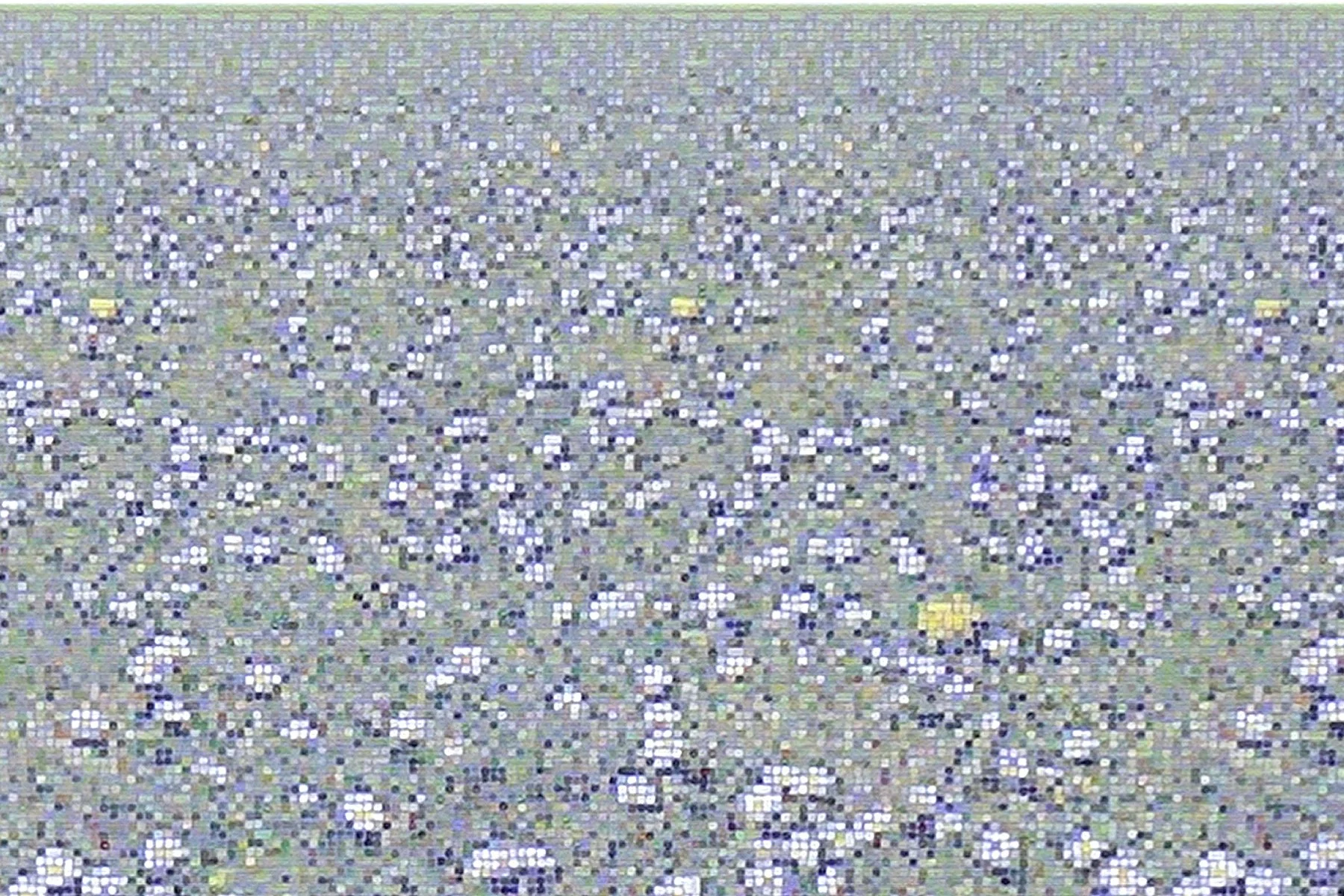
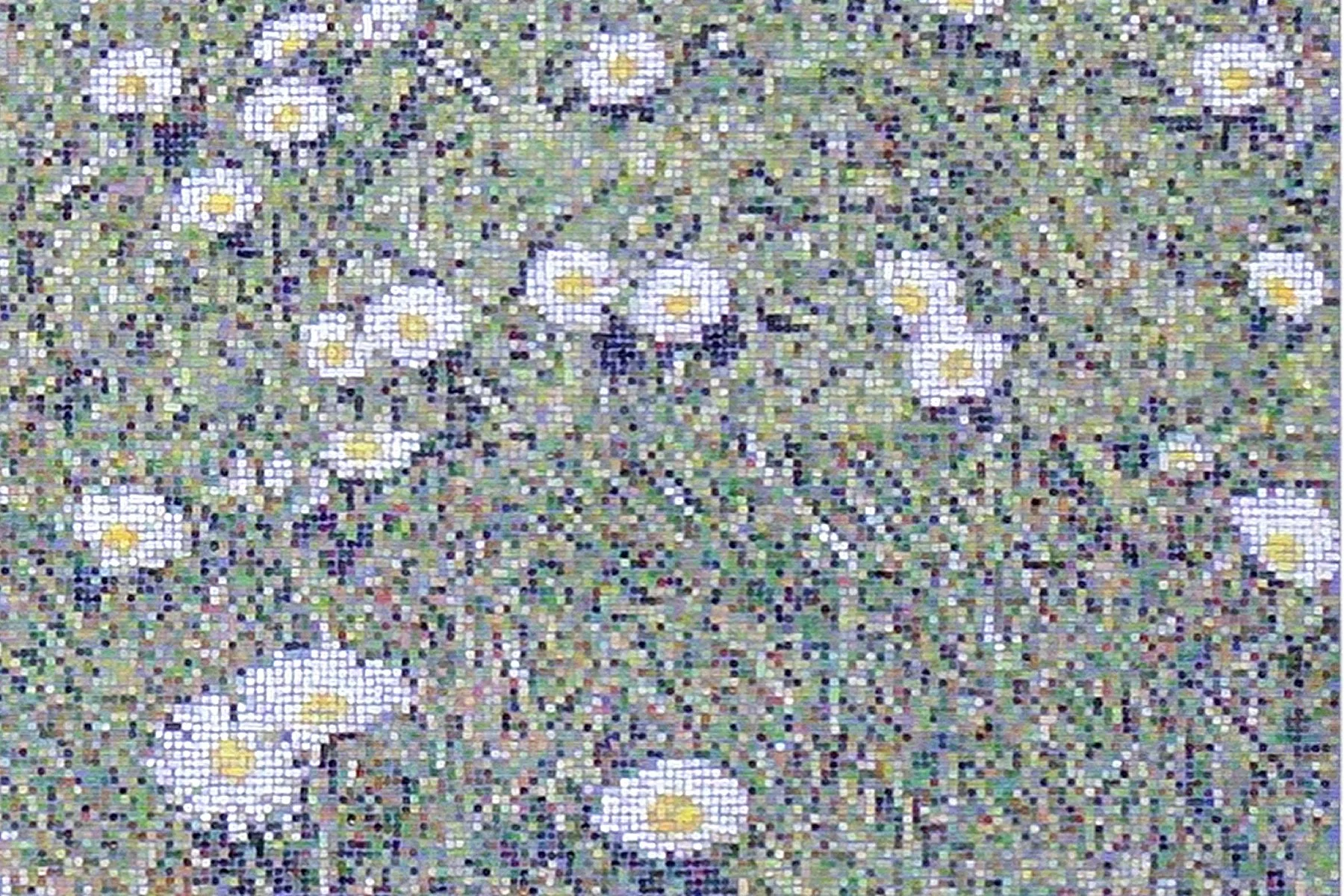
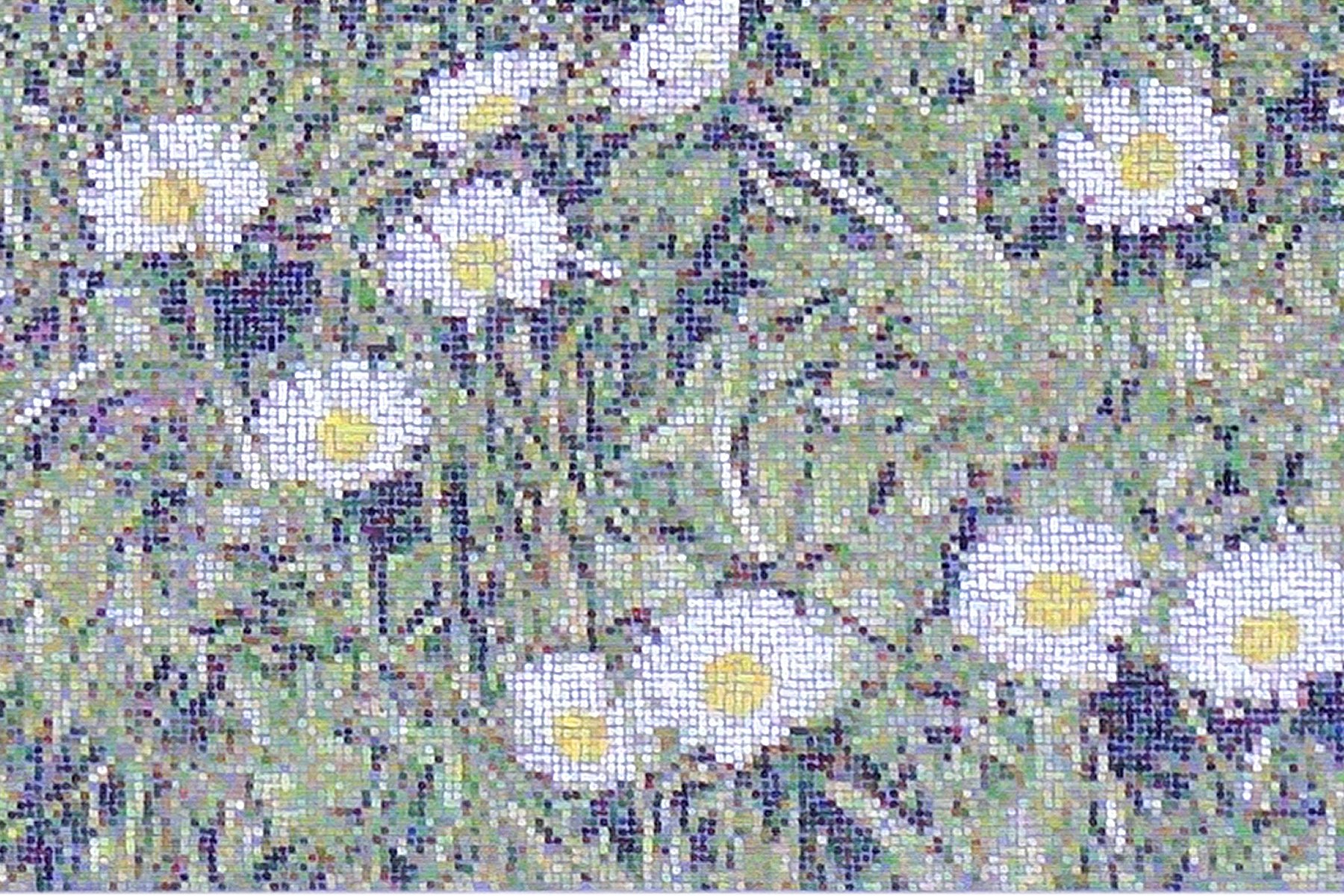
Three print details from the top, middle and bottom of the painting.
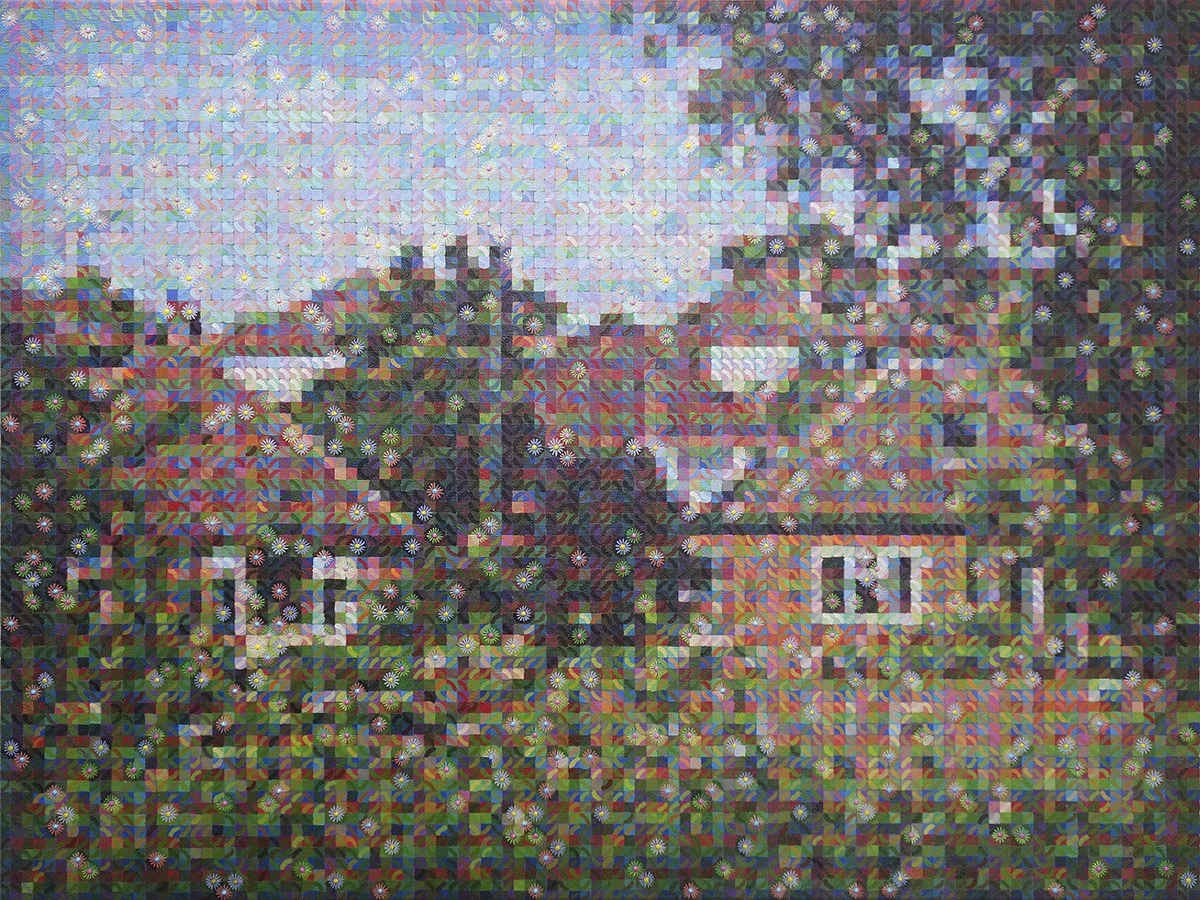
Daisyworld (2017), oil on canvas, 75 x 100cm.

The image being assembled in Photoshop - showing two of the nine layers.
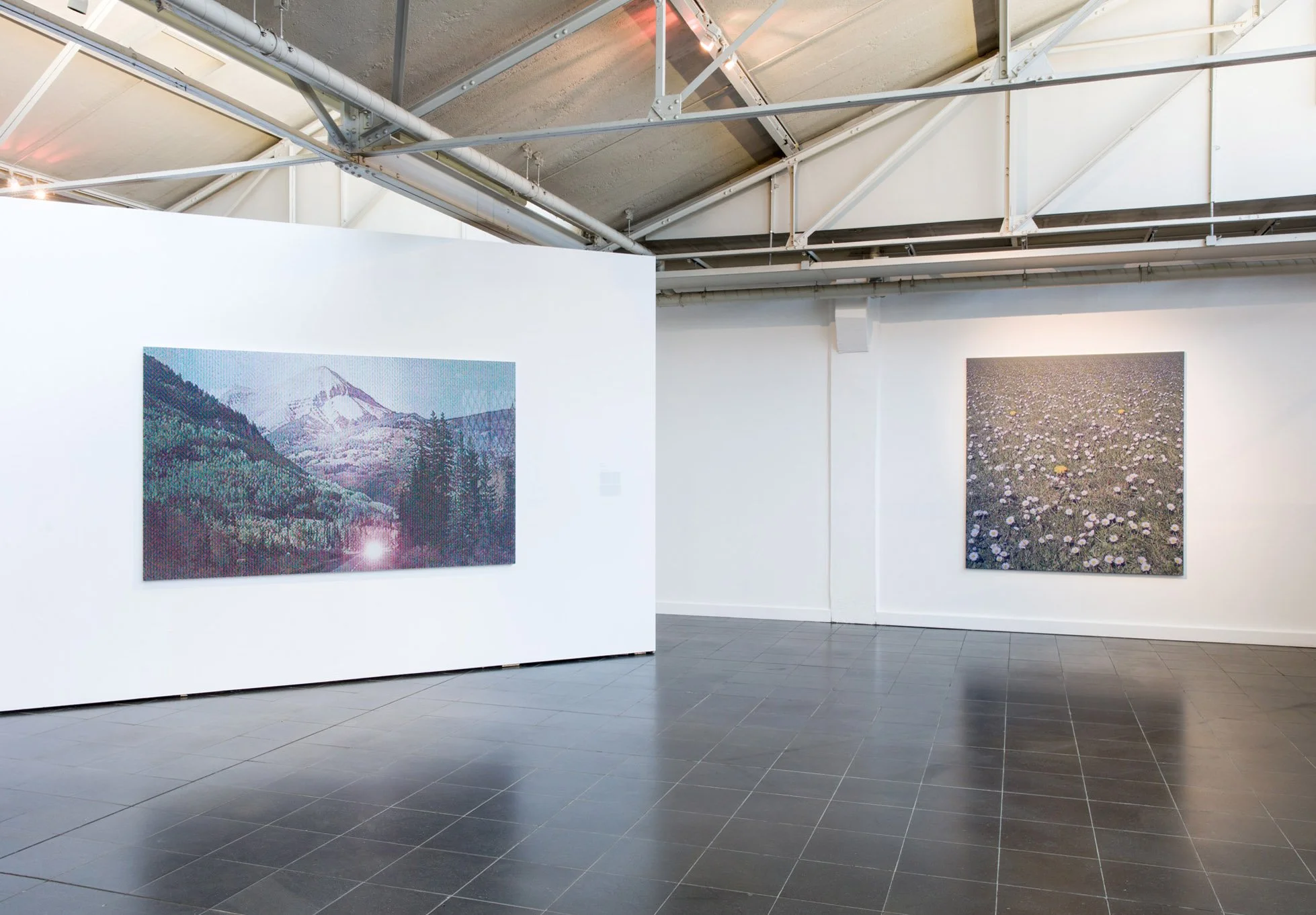
Wanderlust and Daisyworld 2.0 exhibited in Pattern and Decoration: Ornament as Promise. Ludvig Forum Aachen, Germany, 2018.
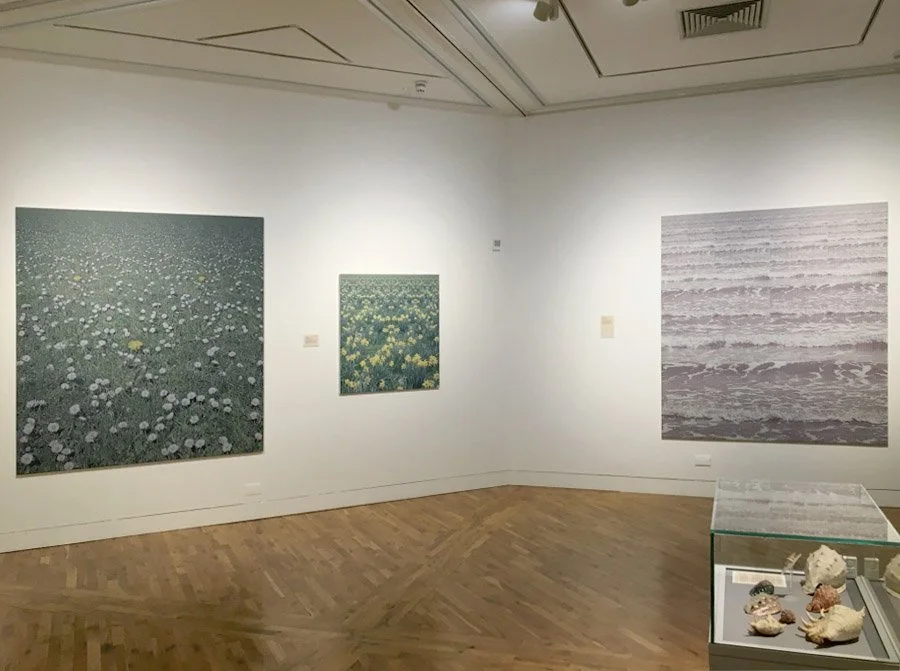
Daisyword 2.0, Clean New Music, and Jeux de Vagues exhibited in “Is This Planet Earth?” at Ferens Art Gallery, Hull, 2019. (Shown alongside astonishing seashells from the Ferens’ Natural History collection, which the curator of the touring exhibition, Angela Kingston, incorporated so fittingly).
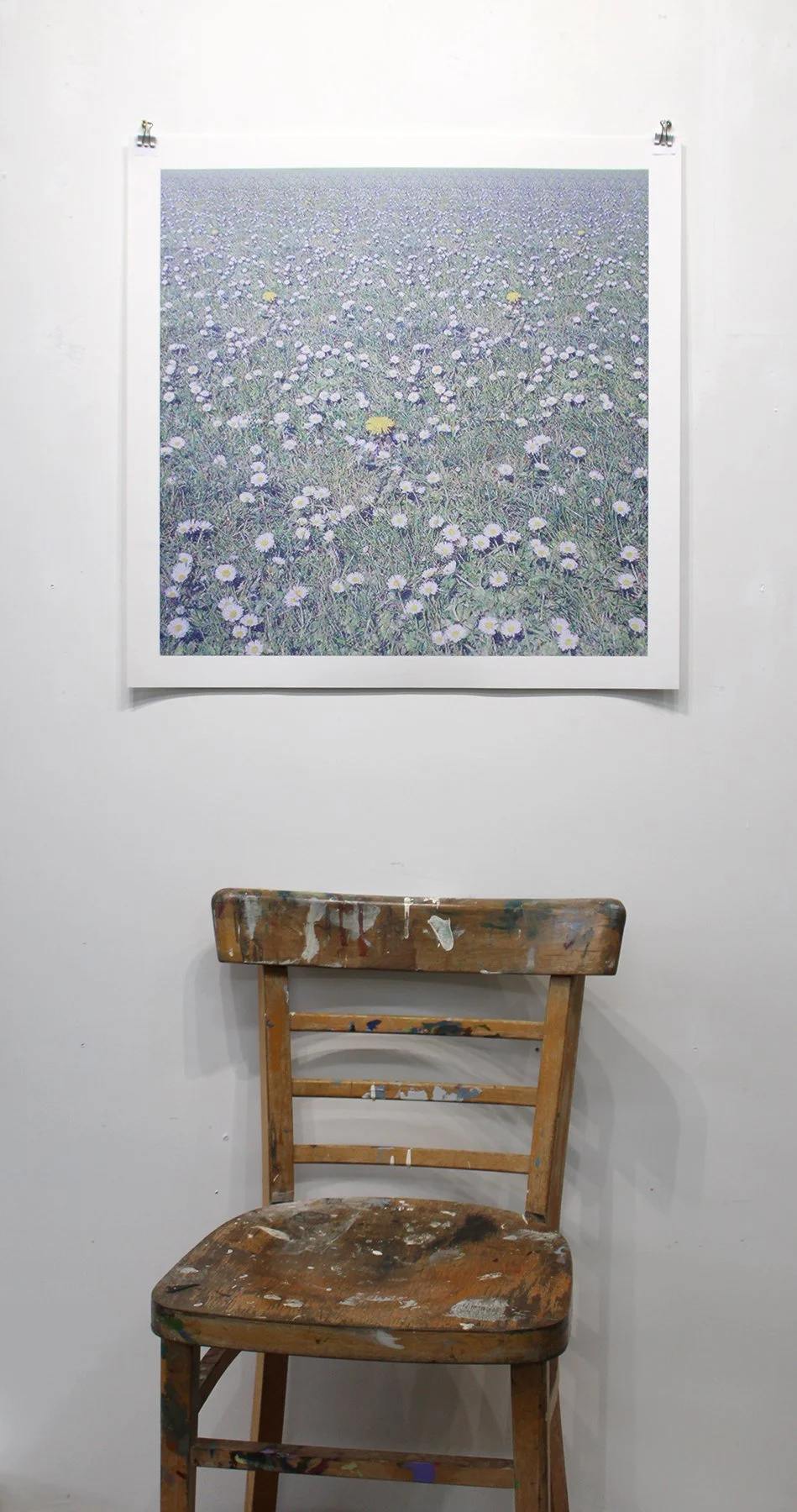
Daisyworld 2.0 test print above a studio chair to give a sense of scale.