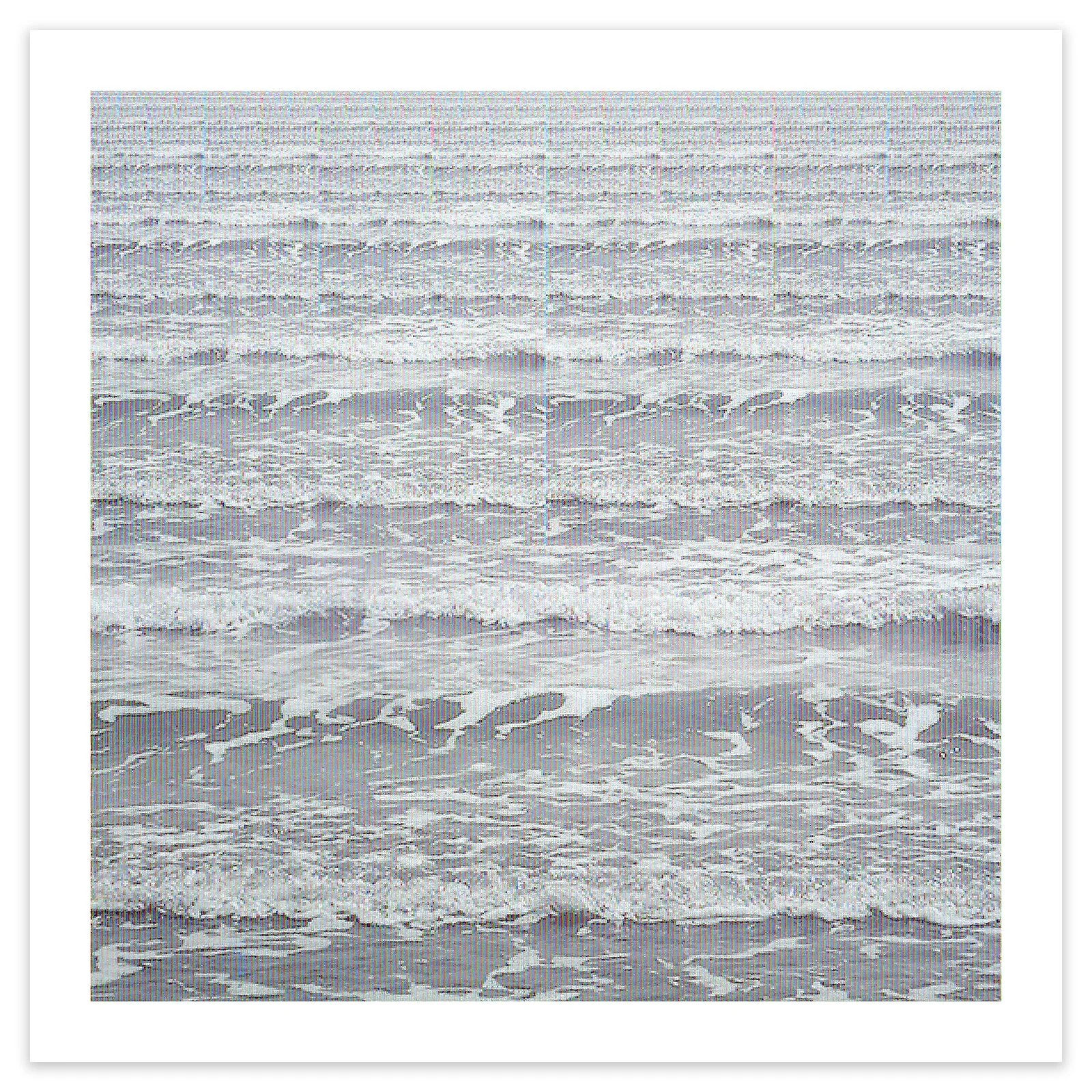
Jeux de Vagues (2018/2026)
Archival pigment inkjet (giclée) print on Hahnemühle Photorag paper (308gsm).
60cm x 60cm / 23.6” x 23.6” (a standard frame size).
53cm x 53cm / 20.8” x 20.8” (image size)
Edition of 128
£150 (+shipping)
The print number (n/128) is printed in the bottom right-hand corner.
A certificate of authenticity accompanies the print.
Shipping costs are calculated at the checkout when your address is entered.
This print is based on a photograph of my painting Jeux de Vagues (2018), oil on canvas, 200 x 200cm. The relatively large size of the print has been chosen so that at close range it is possible to see the image is painted while dissolving into greyscale from a few meters away in a domestic space. I chose a narrow border as the image shows a section of an endless series of repeated waves that want to expand beyond the frame.
Jeux de Vagues can be translated as ‘play of waves’, ‘wave games’ or ‘wave patterns’. Electromagnetic, technological, societal, political or generational waves might, metaphorically, swim around any interpretations.
Around a decade after the Colorado Snow Effect paintings that played with representing an ostensibly greyscale scene in saturated colours (as with the prints Colorado Snow Effect 4 & 6), I found a new, ostensibly greyscale subject to toy with, yet limited to the palette of red, green and blue (RGB). The repeating composition owed everything to Daisyworld 2.0, yet I found a way to undermine this supposed seamlessness with a compositional flaw that took things a bit further.
In an interview in 2015 I was asked about my earliest memory of art, and I replied: “hearing a bewitching piece of flute music on the radio aged around eight. It haunted me, and several years later I heard it again, discovering it was Syrinx by Claude Debussy.” It is my first memory of being profoundly struck by something both familiar and other-worldly, although there are probably many pictorial examples in children’s books or films – yet these are not attached to a singular place and time in my early memory. I was in our kitchen while my mum was preparing Sunday lunch as I closely watched her chopping vegetables and slowly mixing the batter for Yorkshire puddings. My whole sensual appreciation of my everyday surroundings was transfigured by a conflation of sound and vision.
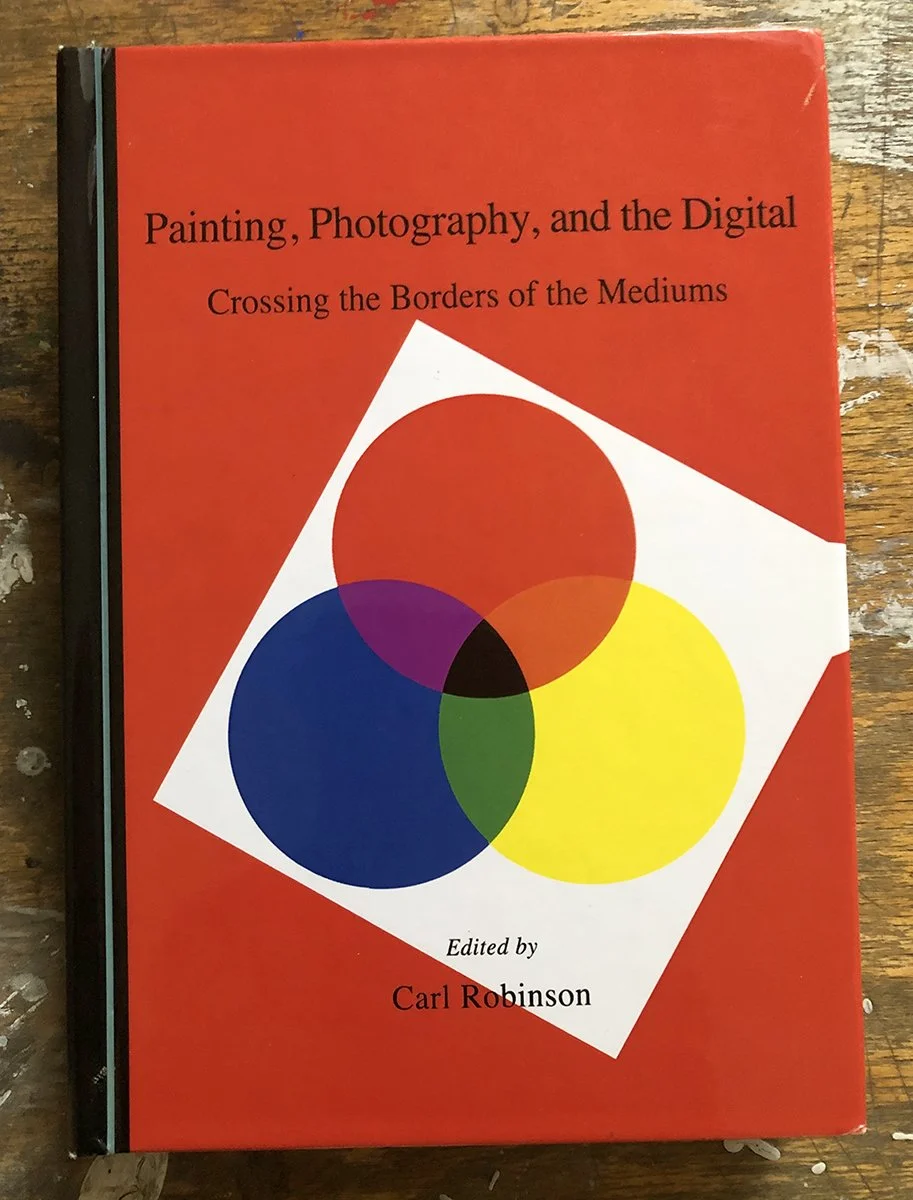
In 2022 I wrote about Jeux de Vagues in an essay titled From Daisyworld to Debussy: Chasing the Vanishing Pixel, which was published alongside 15 other artist contributors in an anthology edited by Carl Robinson: Painting, Photography, and the Digital: Crossing the Borders of the Mediums. (Cambridge Scholars Publishing, 2022).*
I recommend the book and its two earlier sister publications: Painting Digital Photography: Synthesis and Difference in the Age of Media Equivalence (2018); Photography Digital Painting: Expanding Medium Interconnectivity in Contemporary Visual Art Practices (2020).
Following is a slightly edited excerpt from my essay:
2018 was the centenary of Claude Debussy’s (1862-1918) death. Since my teens I have been a fan of his music (especially for piano), and I felt the urge to commemorate him in some way. The tessellated receding perspective of Daisyworld 2.0was looking for a new subject, and on a hunch, I visited the seaside resort of Eastbourne to photograph the sea. I had long been tickled by the seeming irony that Debussy had completed his celebrated orchestral suite La Mer (1905)while staying at the Grand Hotel. After more research it became clear that his sojourn in England was in order to exile himself from Parisian scandal, eloping with his lover Emma Bardac who was pregnant with their daughter, until things quietened down. There is some dispute, but correspondence with his publisher suggests that he only made corrections to the manuscript of La Mer before publication, rather than composing any new material while staying in Eastbourne.
Unsurprisingly, the waves of Eastbourne could not have inspired Debussy’s wildly radical and expressive composition. He described Eastbourne as “a charming peaceful spot: the sea unfurls itself with an utterly British correctness.”** Indeed, he insisted that pictorial representations of the sea inspired him more than the actual thing, a version of Katsushika Hokusai’s (1760-1849) woodblock print The Great Wave of Kanagawa (1831) being used to illustrate the cover of his manuscript.
Painting the waves at Eastbourne would pay forlorn homage to an unrealisable mission: to somehow commemorate Debussy and the imagined tidal surges and swells that inspired La Mer, working from photographs of the tame seaside waves at the place where he resided after composing the work.
After viewing and testing all my photographs and film footage, I found one singular image of waves that successfully formed a tessellating repeat in the manner of Daisyworld 2.0. The shapes of the sea foam have a figurative quality that reminded me fondly of dancing my daughter over the incoming waves when she was little. Being quite a cloudy day, the sea had very little colour modulation, so I made it a greyscale image in Photoshop. Then I introduced vertical red, green and blue strips, echoing the familiar make up of televisual images, albeit in low-resolution. Through the repeats, the order of these colours is alternated through the six variations (RGB, GRB, BRG, RBG, GBR, BGR), creating glitches in the receding perspective.
Titled Jeux de Vagues (Play of the Waves, Wave Games, or Wave Patterns), after the second movement of La Mer, the “play” has as much to do with pixelated optical effects and perceptual confusions as the ordered repetition of the waves, which goes against the intrinsically chaotic nature of the subject. The blurred flattening of the waves as they retreat into lower resolutions is countered by a corresponding increase in the agitation of colours. Despite its frozen motion, electromagnetic waves of colour excite or trouble perception of the image. A darker undercurrent might be read in the sense that the water appears corrupted or polluted, or that this sea carries present-day exiles across its perilous waters, the waves never quite reaching the shore.
The print is quite large as the pixel/paint resolution is 511 x 512 (261,632 squares) – substantially more than the earlier snow paintings published on this website, Colorado Snow Effects 4 & 6 (For sure the painting took more weeks to paint - but at least I only had three colours to mix with varying amounts of white).
The painting has been exhibited six times: BiblioTECH: from bookshelf to big data, at The Portico Library, Manchester (2018); "Is This Planet Earth?", Tŷ Pawb, Wrexham, Wales (2018) - touring to Aberystwyth Arts Centre, Wales, and Ferens Art Gallery, Hull in 2019; It's Gonna Rain, Coombs Contemporary, London (2019); and in a solo show, Paysages Fugitifs / Fugitive Landscapes, Galerie Richard, Paris (2022).
Lastly, a delightful story of the painting returning to the musical realm. In 2021 I was contacted by the composer and guitarist Lucio Tasca who had seen my painting and was working on a score inspired by it. As he explains: “this piece is a collection of seemingly identical dots, and wave patterns. It is about gradually getting a blurred image in focus and highlighting the humanity of the handmade through repetition.”
Lucio Tasca - Jeux de Vagues (2021). Played by Alex Raineri, piano. [Link to webpage and recording]
* The other artist contributors to Painting, Photgraphy and the Digital were: Mick Finch, Frances Woodley, Rhys Himsworth, Till Julian Huss, Alison Goodyear, Dawn Woolley and Zara Worth, Martin Lang, Abbie Schug, Clare Strand, Theresia Stipp, Carl Robinson, Frances Guerin, Matt Saunders, Rahma Khazam.
** Nigel Simeone, Debussy and Expression. The Cambridge Companion to Debussy. Simon Trezise (ed.) (Cambridge: Cambridge University Press, 2007), 108.
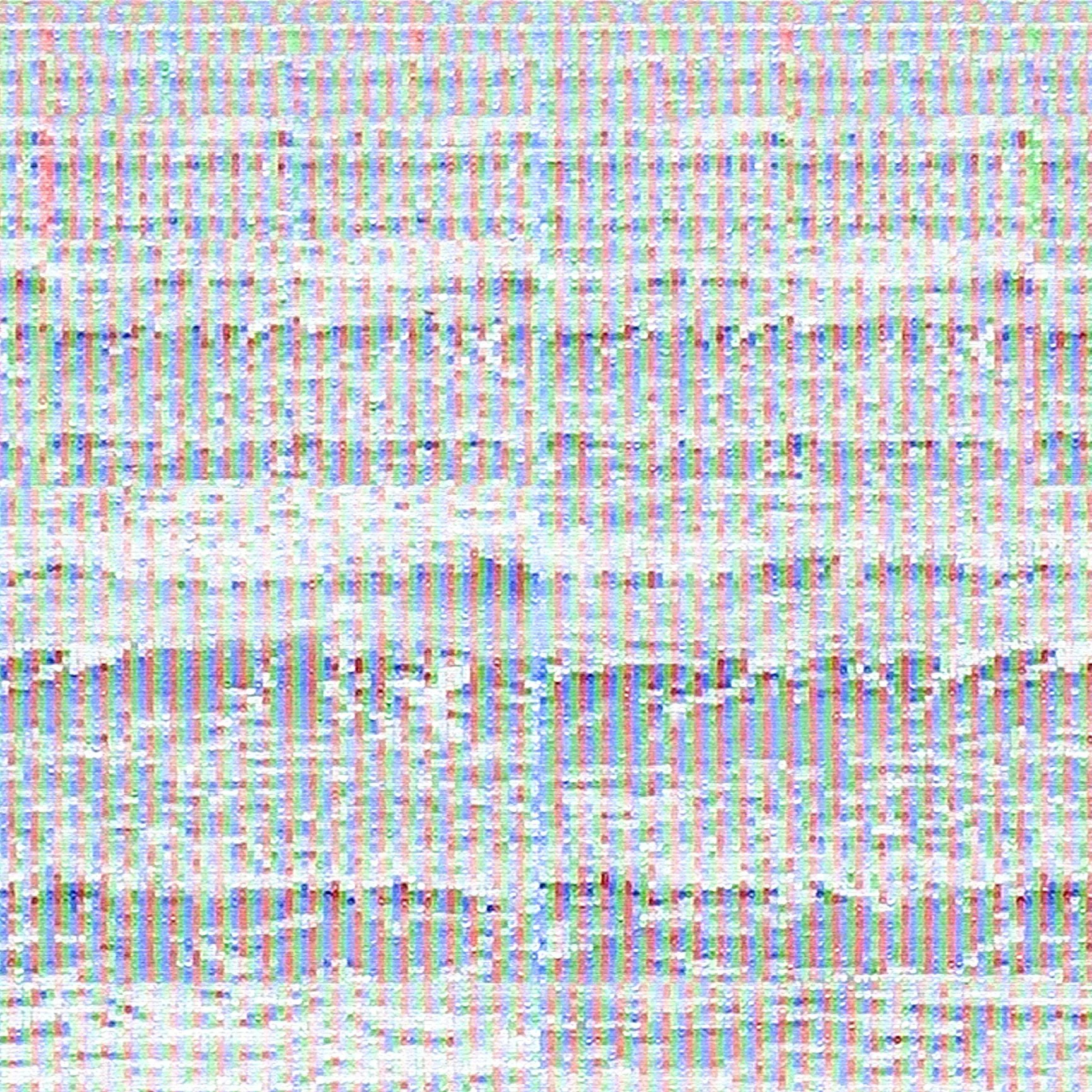
Detail of the print from the top of the painting. The shifts or glitches in the pattern of red, green and blue stripes becomes more agitated as the horizon is approached.
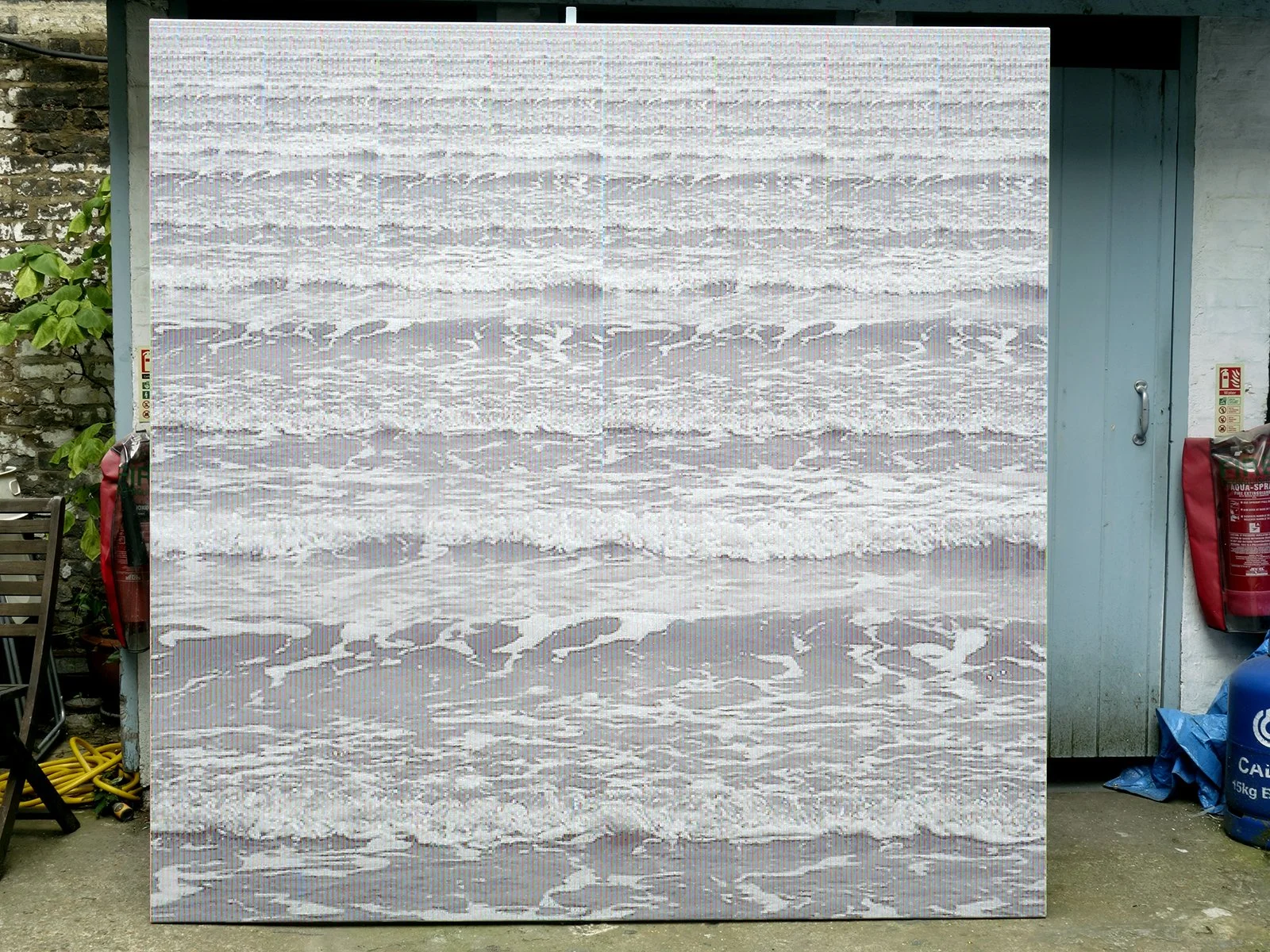
Jeux de Vagues in the studio courtyard before heading off across the waves to France in 2022.
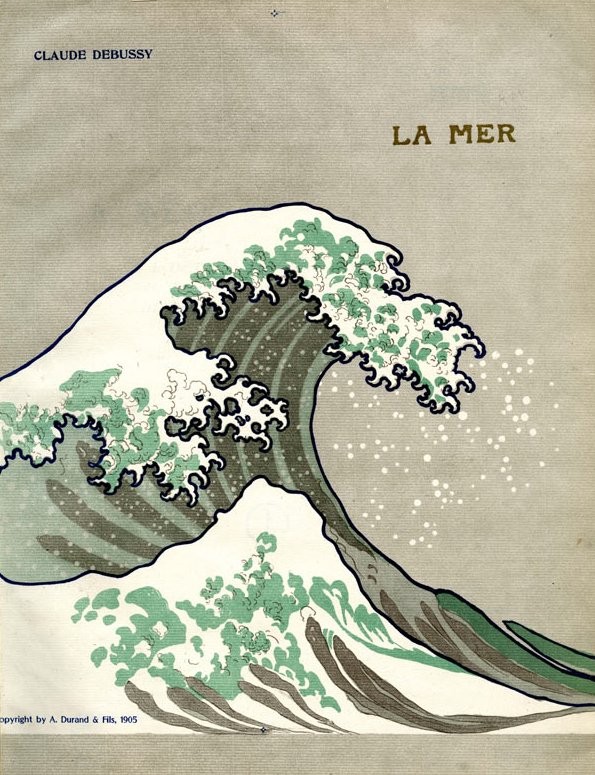
The manuscript cover of Claude Debussy’s La Mer (1905).
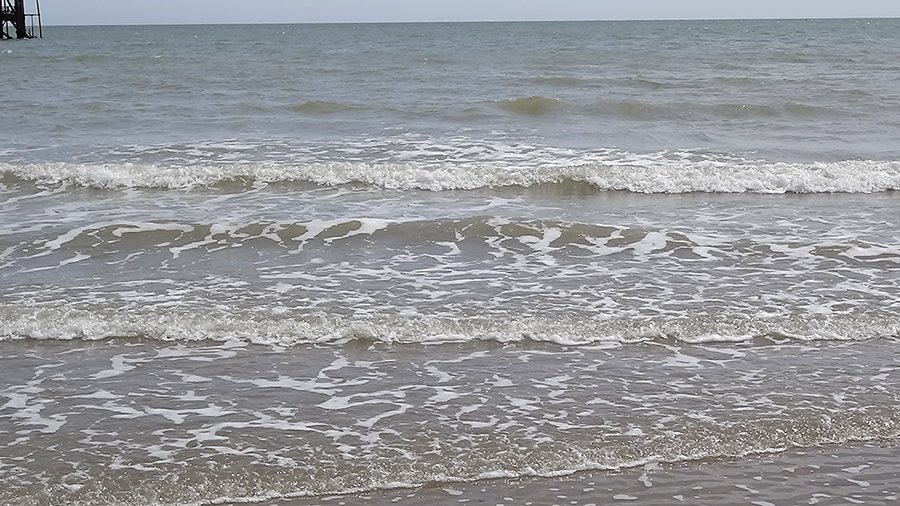
Photograph of the sea at Eastbourne (2018). The structure top-left is the end of the pier.
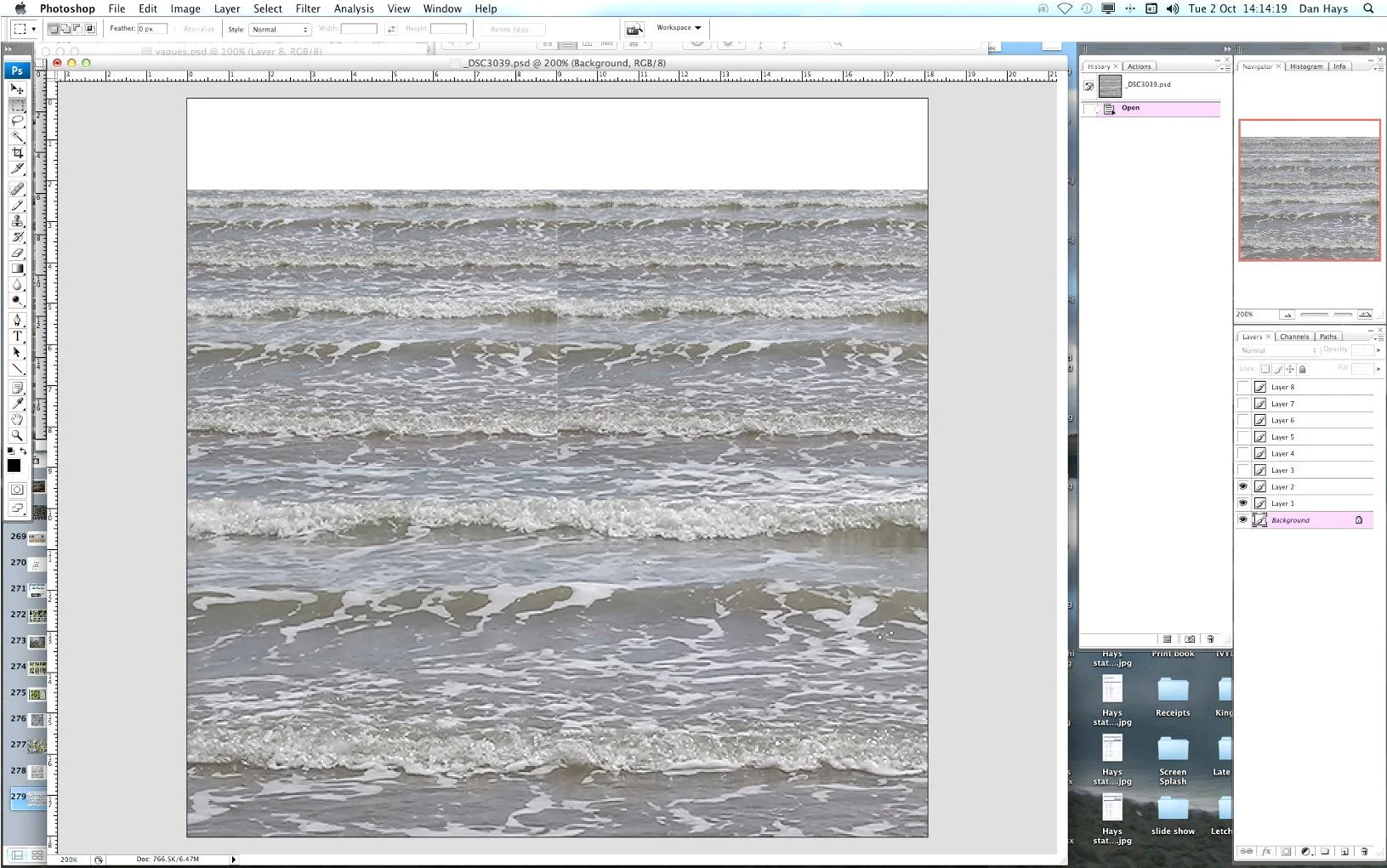
The 2 x 1 section of the image (containing 3 waves) being assembled in Photoshop, repeating twice then four times, before 8, 16, 32, 64, 128, 256 times. (9 strips of image = 27 waves receding to the horizon, halving in height and resolution in each step).
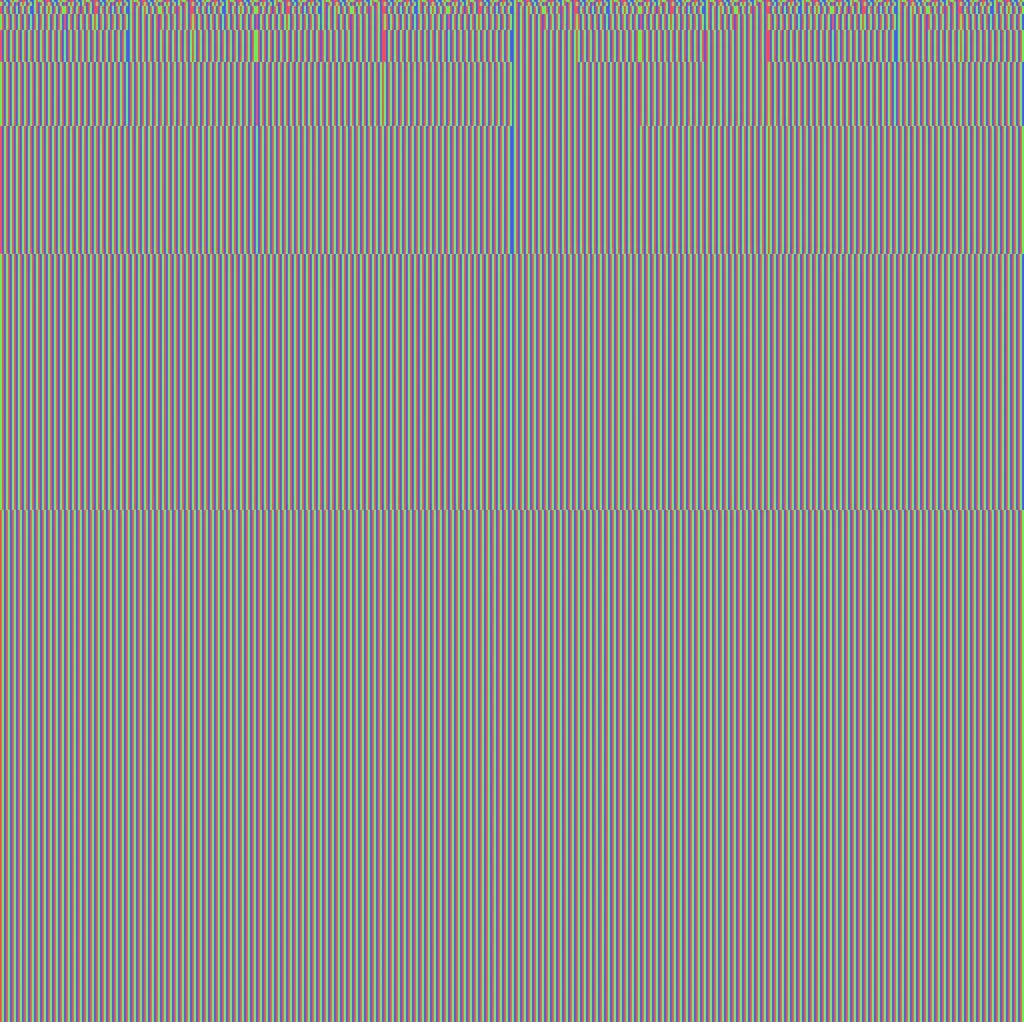
The 512x511 pixel map showing the shifts or glitches in the pattern of red, green and blue between RGB, RBG, GBR, GRB, BGR, BRG.
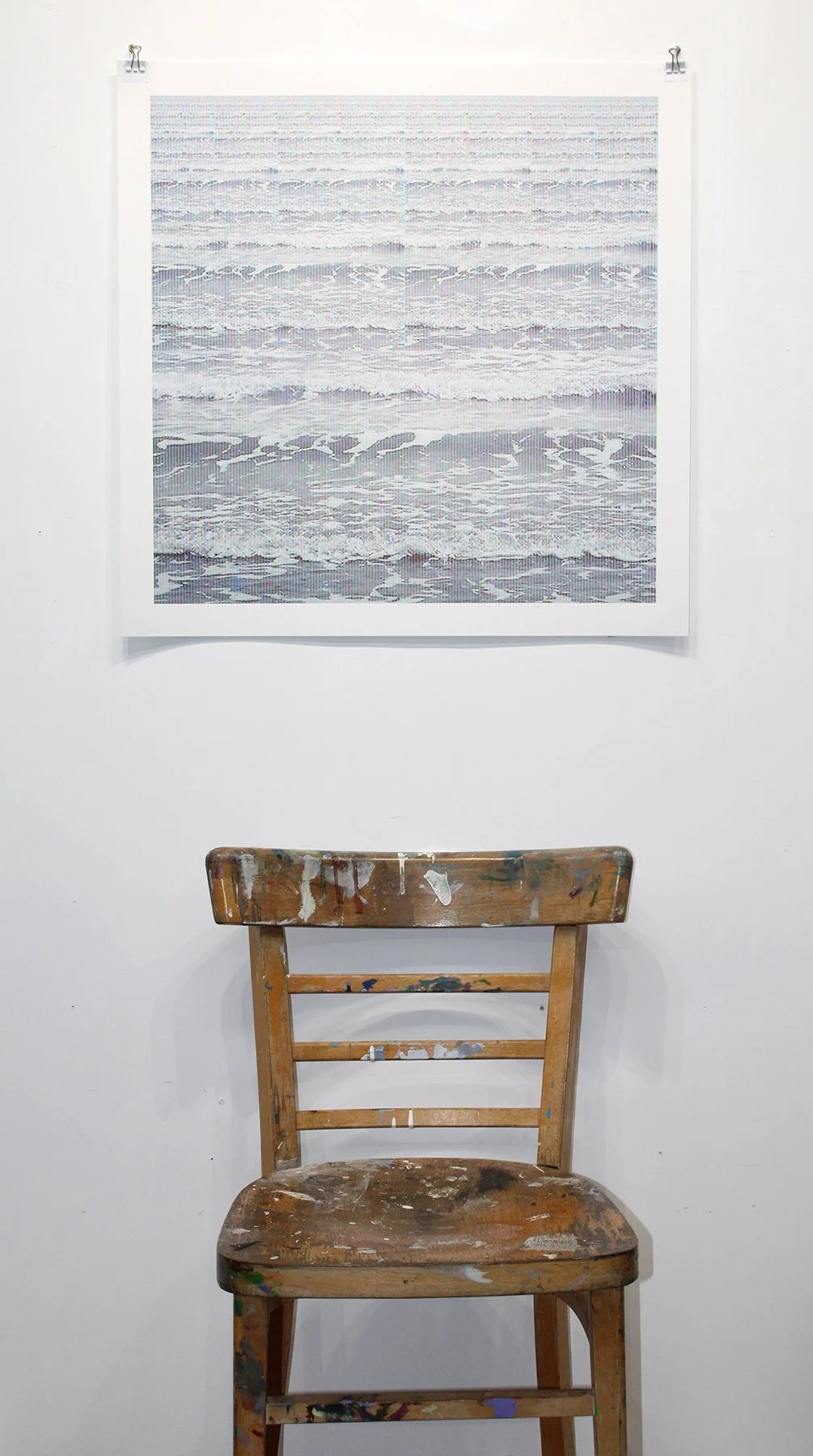
Jeux de Vagues test print above a chair in the studio to give a sense of scale.
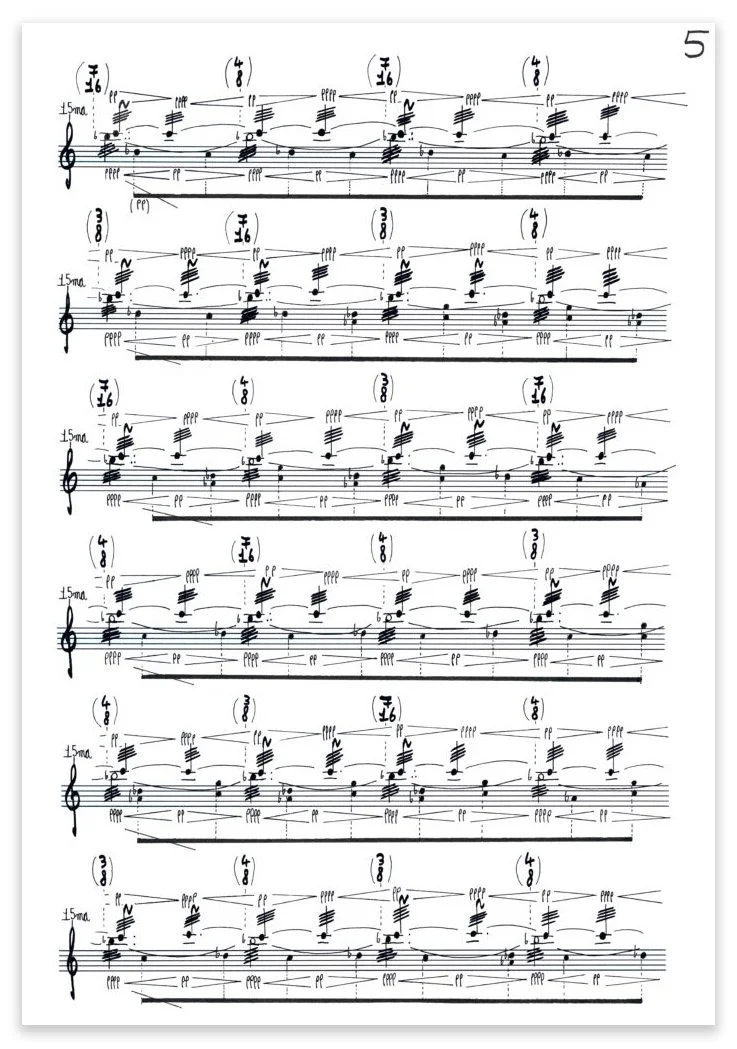
Lucio Tasca - Jeux de Vagues (2021). (Page 5 from the musical score).